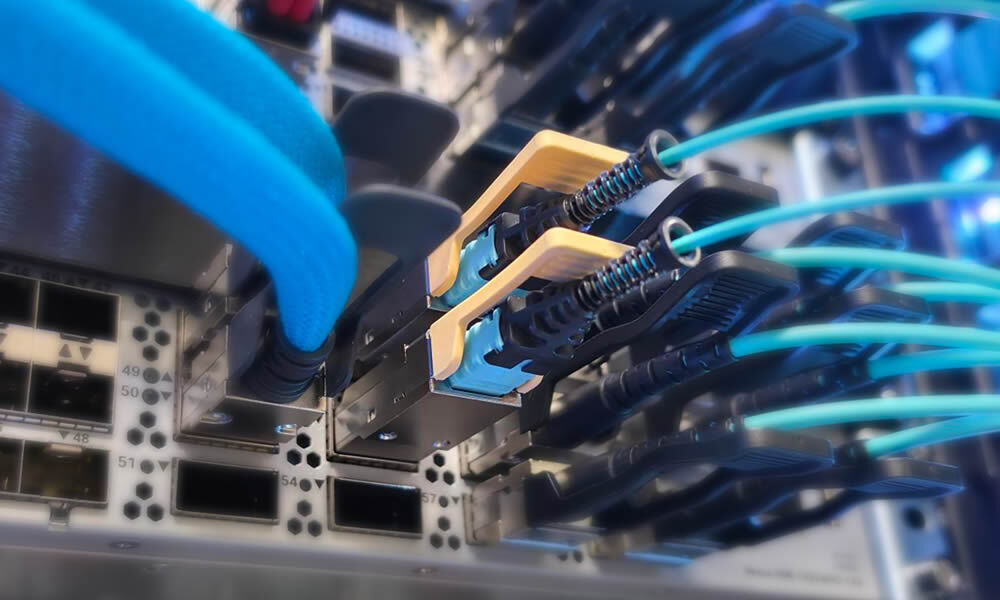
Artificial intelligence is reshaping data center infrastructure at an extraordinary pace. As organizations deploy larger GPU clusters to support AI training and inference, power density, efficiency, and scalability have become defining design constraints. While GPUs and cooling technologies often command the spotlight, one critical factor is increasingly influencing success at scale: network cabling architecture.
From routing strategies to media selection, cabling decisions now play a measurable role in power consumption, latency, serviceability, and total cost of ownership especially as networks move to 400G and 800G speeds.
AI Network Speeds Are Advancing Faster Than Expected
AI back‑end networks are growing faster than traditional front‑end data center networks, driven by applications such as generative AI, large‑scale analytics, and image and video processing. These workloads rely on massive clusters of GPUs connected through high‑bandwidth, low‑latency fabrics.
Siemon’s recent polling of data center and networking professionals highlights just how quickly expectations are shifting. When asked what server interface speeds they plan to deploy within the next five years:
- Over half (52%) indicated 400G and 800G server ports
- 28% expect 100G to remain a core requirement
- Only a small minority plan to stay at 25G or 50G
This data reinforces an important reality. 400G and 800G networking is no longer speculative. It is already embedded in near-term infrastructure roadmaps.
Switch Planning Confirms the Momentum
This momentum is equally evident when looking at switch deployments. A significant proportion of professionals indicated plans to deploy 400G and 800G switches within the next three to five years, while a notable segment is already thinking beyond 1.6T.
The implication is clear. As AI environments scale, network speed increases are happening alongside increases in GPU density. This convergence is what makes efficiency in the physical layer so critical.
Power Density Is Redefining Rack and Network Design
A single GPU server node can draw approximately 8 kW. Depending on whether a data center supports 20 kW, 40 kW, or even 100 kW per rack, GPU clusters may be spread across multiple cabinets or condensed into extremely dense footprints.
As density increases, so does sensitivity to inefficiencies. Longer cable routes, higher‑power optics, and poorly managed bundles quickly compound into higher cooling loads, restricted airflow, and increased operational cost.
In this environment, cabling is no longer just about connectivity. It directly affects how much infrastructure a rack can realistically support.
Why Routing Strategy Makes a Difference
Routing strategy is often underestimated in high‑speed designs. Vertical routing up and over cabinets can significantly increase cable length. Horizontal routing, by contrast, shortens the distance between adjacent cabinets and enables more efficient media choices.
This distinction becomes especially important at 800G speeds. Shorter routes open the door to greater use of copper cabling, which offers advantages in power consumption, latency, and cost when distances allow.
Horizontal routing has already become standard practice in many hyperscale AI deployments and is being formalised in emerging industry reference designs. As more organizations plan for 400G and 800G networks, routing efficiency is increasingly foundational rather than optional.
Copper Is Evolving to Meet AI Density Requirements
Copper cabling has long been valued for low latency and low power consumption, but traditional designs made flexibility and density a challenge at very high speeds. That is changing.
Modern high-speed copper cable constructions have improved bend radius and reduced outer diameter, allowing them to be used effectively in dense AI environments. In practical terms, this means copper can now support high‑density horizontal or even vertical routing without exceeding bend limits or congesting cabinet cut‑outs.
From an efficiency standpoint, the advantages are compelling. Passive copper connections consume a fraction of the power required by DSP‑based optical transceivers, while newer active copper designs using re‑driver chips provide a practical middle ground, supporting distances of up to five meters with lower cost and lower power consumption than DSP‑based active electrical cables. Together, these options continue to deliver the lowest available latency where copper can be applied.
The Power Impact Becomes Significant at Scale
It’s true that GPUs consume far more power than network connections but Siemon’s polling data shows that many AI deployments are planning for hundreds or thousands of GPU links. At that scale, networking power is no longer negligible.
In comparative scenarios, traditional all‑optical designs for GPU and leaf‑to‑spine connections can consume tens of kilowatts purely in transceivers. By contrast, an efficient mix using copper for short‑reach GPU connections and low‑power optics with structured fiber for longer switch‑to‑switch links can reduce networking power consumption by more than half.
When extrapolated across large AI clusters, these savings translate directly into reduced cooling requirements, lower operating costs, and improved sustainability metrics. Cost also becomes significant at this scale. Introducing copper for suitable short‑reach GPU or leaf‑to‑spine connections can help keep projects on budget, with one recent large‑scale deployment reporting savings of more than $40 million simply by identifying effective use cases for copper.
Preparing for What Comes After 800G
Poll results also suggest that some organizations are already anticipating post‑800G environments. While new technologies such as co‑packaged optics are on the horizon, the fundamental principle remains the same: efficiency is achieved by matching the connection type to the application, distance, and density.
High-speed copper, fiber, AOCs, and emerging optical architectures will all have a role to play. The most successful AI data centers will be those designed with flexibility rather than reliance on a single connectivity approach.
Cabling as a Strategic Design Lever
The combination of faster network speeds, higher power density, and accelerating AI adoption is pushing cabling out of the background and into a strategic role. Industry feedback confirms that 400G and 800G are already core design speeds, not future considerations.
As AI environments scale, every watt, every meter of routing, and every design decision adds up. Thoughtful cabling architecture grounded in efficiency, routing clarity, and appropriate media selection can make the difference between an AI data center that merely functions and one that scales sustainably.

Ryan Harris
Director of Sales Engineering
Ryan Harris is the Director of Sales Engineering with Siemon, headquartered in Watertown, CT. Ryan has over 15 years’ experience as a customer facing Sales Engineer supporting network equipment OEM’s, hyperscale end-users, ODM’s and system integrators with point-to-point cabling solutions. Specializing in deployment of server system connections in both data center and telecommunication environments. Having a strong understanding of Top-of-Rack applications and a track record of staying up to speed with emerging technologies Ryan communicates technical benefits to provide best-in-class core DC and Edge solutions. With a goal to help Network Engineers understand their options to deploy systems on-time and on budget with attention to detail and a strong customer service ethic.
Smart Insights, Straight to Your Inbox
Subscribe to Siemon’s blog for expert insights on data centers, smart buildings, cabling standards, and sustainability. Stay ahead with technical tips, industry trends, and connectivity innovations.